Why Independent EV Battery Testing Is Imperative Before Buying a Secondhand EV
Published
Buying a used electric vehicle is fundamentally different from buying a combustion-engine car.
The engine is no longer the primary concern. The battery is.
The high-voltage battery is the most expensive component in any EV, yet mileage alone tells you very little about its true condition. Two vehicles with identical odometer readings can have dramatically different usable range, reliability, and long-term value.
That’s why independent EV battery testing is now a critical step in the secondhand buying process. A professional EV battery health check removes guesswork, replaces assumptions with verified data, and protects buyers and sellers from costly surprises.
The Hidden Risks: Why Standard Checks Aren’t Enough for EV Battery Testing
The Odometer Myth
Low kilometres do not automatically mean good battery health.
EV battery degradation is influenced by factors unrelated to distance travelled, including:
- Battery age
- Long periods at 0% or 100% charge
- Storage conditions
- Exposure to heat and cold
- Charging patterns over time
A lightly driven EV that has been poorly stored can show worse battery health than a higher-kilometre vehicle that has been consistently used and managed correctly.
Dashboard Deception
Relying on the dashboard display alone is risky.
Most manufacturers build buffer zones into EV batteries that are hidden from the driver. As a result, a vehicle can still display 100% charge or healthy range estimates even after measurable degradation has already occurred.
Only independent EV battery diagnostics that communicate directly with the Battery Management System (BMS) can reveal the true usable energy and real battery condition.
Common Issues Missed Without Professional EV Battery Diagnostics
Cell Imbalance
EV batteries are made up of hundreds, and sometimes thousands, of individual cells.
If one cell degrades faster than the rest, it can limit the performance of the entire pack. This may result in:
- Sudden drops in range
- Inconsistent charging behaviour
- Reduced usable capacity
- Unexpected shutdowns under load
A simple State of Health figure may not detect this. Professional EV battery testing includes cell-level analysis to identify imbalance early.
Rapid Degradation
A small percentage of EVs experience accelerated battery degradation due to manufacturing variance or early-life faults.
When identified early, these issues may be addressed under the manufacturer's warranty. When missed, they can become a significant ownership cost. Independent testing helps identify these vehicles before the risk transfers to the buyer.
How Independent EV Battery Testing Works
The Technology Behind the Test
Professional EV battery testing uses specialised diagnostic hardware that connects directly to the vehicle's Battery Management System. Equipment such as the Aviloo system communicates via the OBDII port or model-specific interfaces, including Tesla-specific connectors. This allows access to battery data that is not visible through the dashboard.
The Testing Process
The Flash Test
The Flash Test is a static assessment performed while the vehicle is parked.
- Takes approximately 3 minutes
- No driving required
- Captures key battery metrics directly from the BMS
- Ideal for pre-purchase assessments and quick evaluations
From Data to Decision: The EV Battery Certificate
Once testing is complete, the data is uploaded securely for cloud-based analysis.
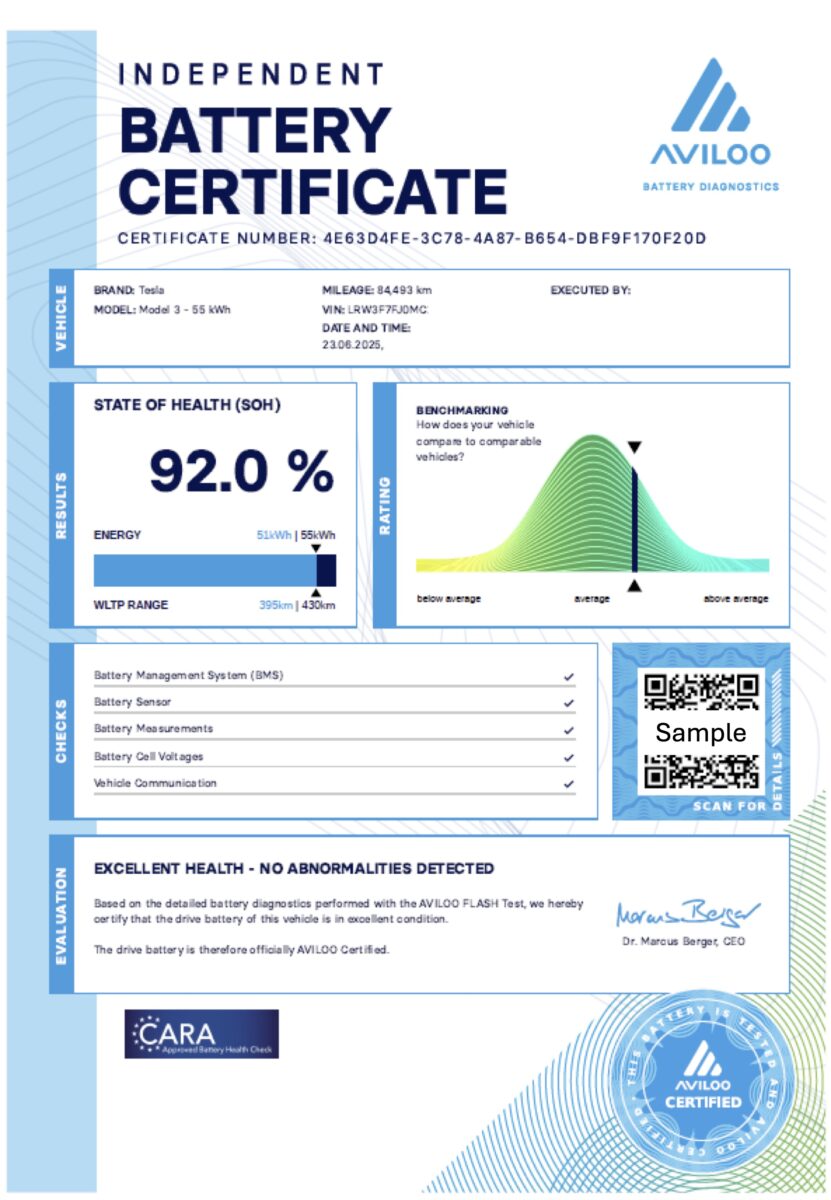
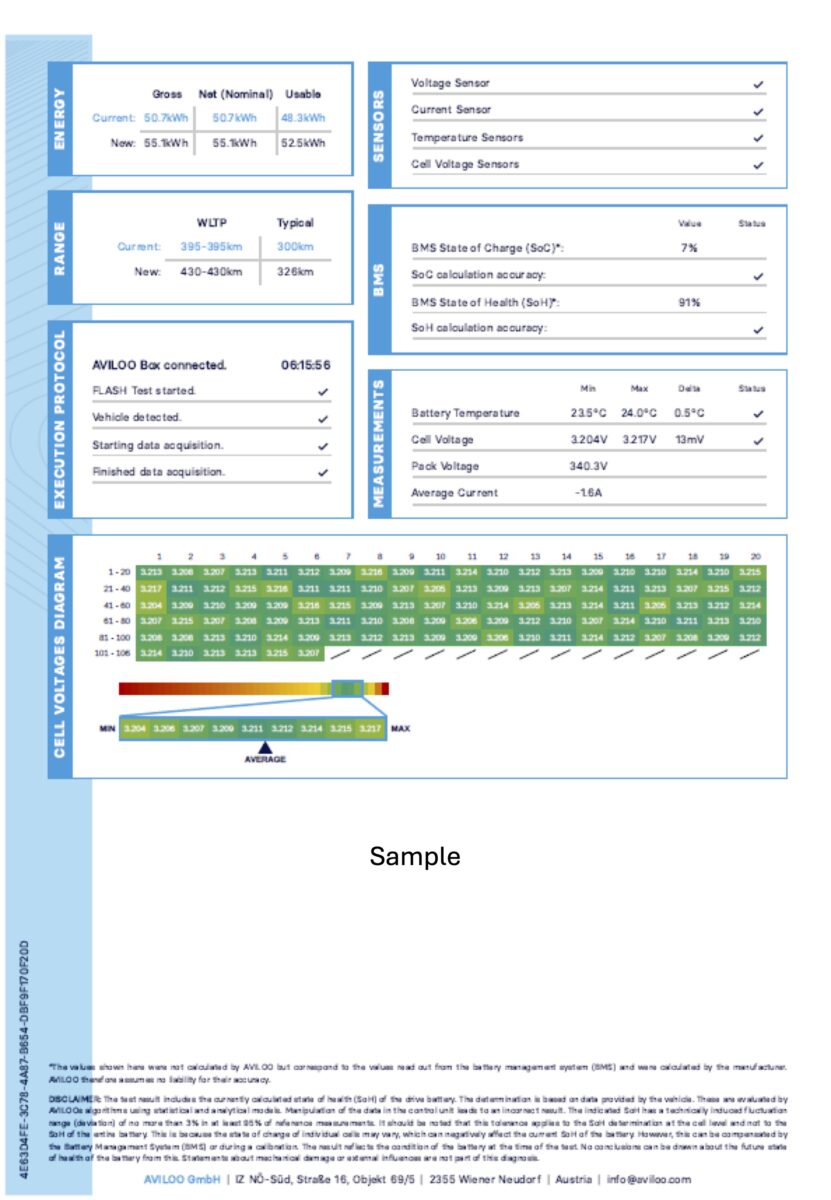
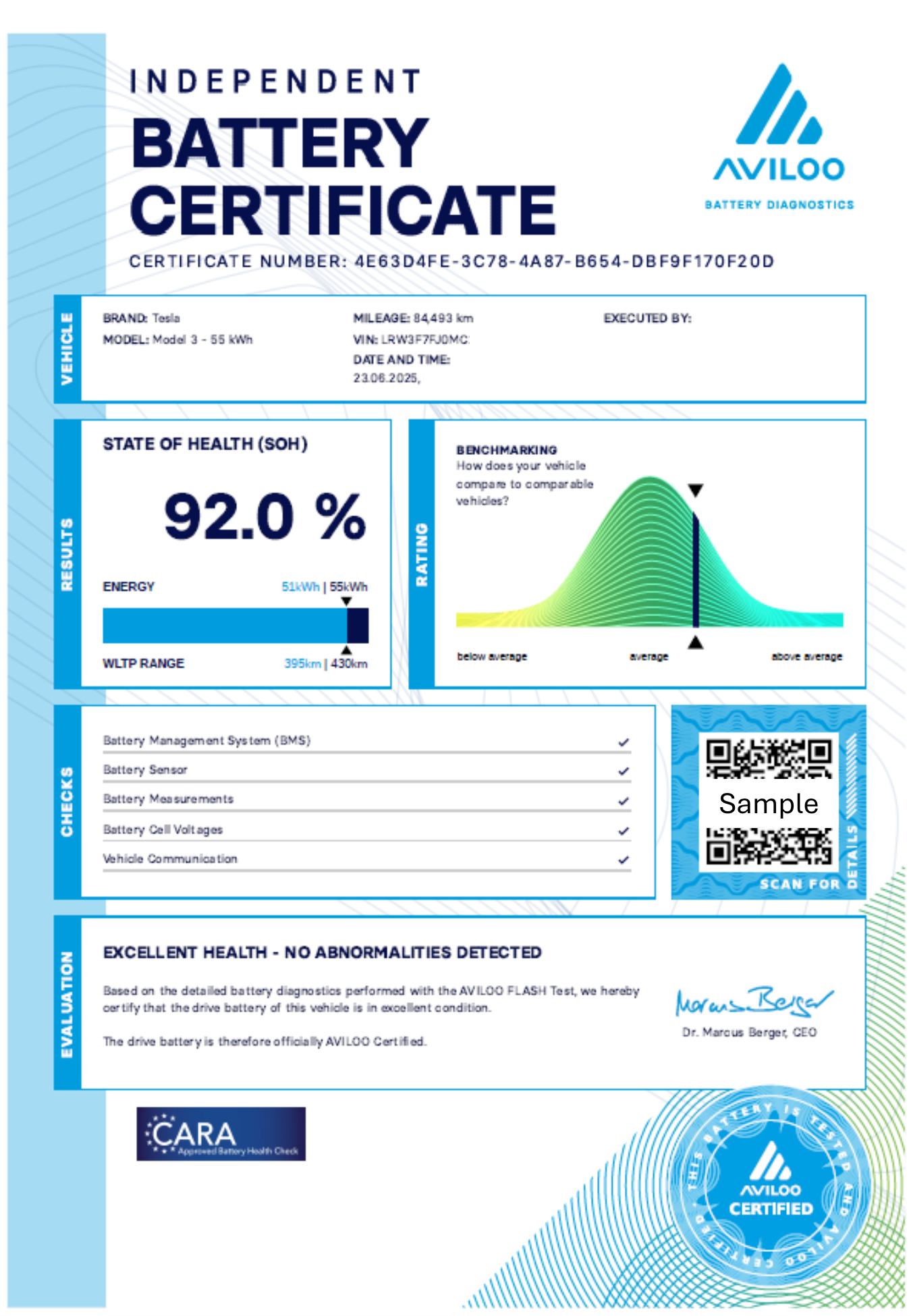
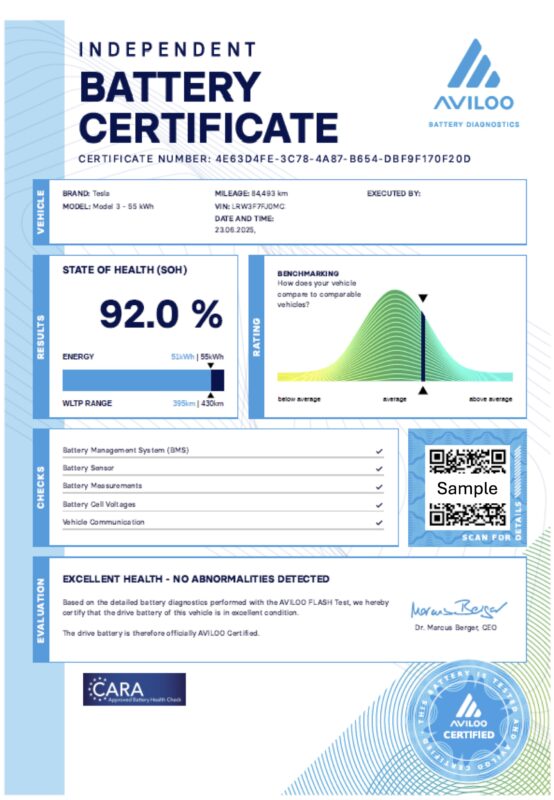
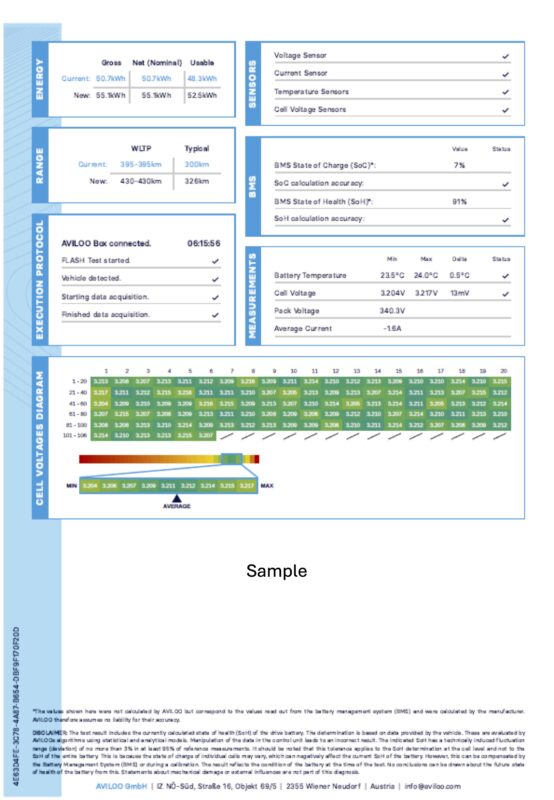
Results are benchmarked against thousands of comparable vehicles of the same model, age, and specification. The outcome is an independent EV battery certificate detailing:
- Battery State of Health (SoH)
- State of Certified Energy (SoCE)
- Cell balance and voltage distribution
- Performance comparison against similar vehicles
This report provides objective clarity for both buyers and sellers.
Interpreting Your EV Battery Test Results
State of Health (SoH)
SoH represents the remaining usable capacity of the battery compared to when it was new.
For example:
- 100% SoH equals original usable capacity
- 90% SoH equals 10% capacity loss
- 80% SoH equals a noticeable reduction in real-world range
Why SoCE Matters
Advanced EV battery testing goes beyond a single percentage.
State of Certified Energy reflects how much energy the battery can actually deliver under real conditions. Combined with cell voltage analysis, it provides a more accurate picture of day-to-day usability.
What Is a “Good” Battery Health Score?
The 70% Warranty Threshold
Most EV manufacturers warrant their batteries down to approximately 70% State of Health.
Below this point, range, charging behaviour, and practicality often decline significantly.
Benchmarking Against Similar Vehicles
Independent EV battery testing compares your vehicle against others of the same model and age. This context allows results to be clearly defined as:
- Above average
- Within expected range
- Below expectations
This comparison is critical when assessing value.
Why Choose Accelerate Automotive for EV Battery Testing
Accelerate Automotive is a specialist European workshop with advanced expertise in EV and hybrid platforms from Mercedes-Benz, BMW, Audi, Volkswagen, and Porsche.
Modern European EVs rely on complex battery management systems, high-voltage architecture, and tightly integrated electronics. Accurate battery assessment requires specialist tools and diagnostic experience.
Our approach is:
- Diagnostic-led, not assumption-based
- Independent and manufacturer-aligned
- Focused on transparency and clarity
EV battery testing is often performed alongside our EV and hybrid pre-purchase inspections, giving buyers a complete picture of mechanical, electrical, and battery condition.
If you’re considering a secondhand EV, we recommend reviewing our detailed guides:
Together with independent EV battery diagnostics, these inspections help eliminate risk before purchase.
The Financial Impact of EV Battery Testing
For Buyers
Battery condition directly affects range, usability, and long-term ownership cost.
A 10% difference in battery health between two similar vehicles can represent a meaningful difference in value. Independent testing provides clear data to support informed decisions or negotiation.
BMW i3 Warranty Replacement Success Story
A 2015 BMW i3 owner with degradation approaching the 70% warranty threshold brought their vehicle to a BMW dealer for battery capacity testing. The service advisor initially claimed "BMW doesn't warranty battery degradation" and insisted they only replace batteries that completely fail. After the owner escalated, the dealer ran the proper diagnostic test and discovered the battery qualified for warranty replacement saving the owner between onwards of $30k in replacement costs.
Multiple i3 owners reported similar experiences; one received a new battery valued at $33,000 just six days before their warranty expired.
For Sellers
Providing an independent EV battery certificate builds trust and confidence.
Transparent sellers often experience faster sales, fewer objections, and stronger final pricing.
EV Battery Diagnostics for Fleet Managers
For fleet operators, battery health is central to Total Cost of Ownership.
Independent diagnostics support:
- Accurate residual value forecasting
- Early identification of underperforming vehicles
- Better lifecycle and replacement planning
Data-driven decisions protect long-term fleet value.
Best Practices for Maintaining EV Battery Health
Driving Habits
Aggressive or highly dynamic driving increases energy consumption and thermal load.
It does not preserve battery health.
Consistent, moderate driving supports long-term stability.
Charging Habits
Best practice includes:
- Avoiding prolonged storage at 0% or 100%
- Minimising exposure to extreme temperatures
- Allowing the battery to operate within a moderate charge window when possible
Battery longevity is about balance, not perfection.
Conclusion
EV battery testing is the compression test of the electric age.
It is the most reliable way to understand the true condition, usability, and value of a secondhand electric vehicle. Independent data protects buyers, supports sellers, and reduces long-term risk.
Don’t buy blind.
Book an EV battery health check with Accelerate Automotive and make decisions based on verified data, not assumptions.
Frequently Asked Questions (FAQs)
1. How long does an EV battery health check take?
The static Flash Test takes approximately 3 minutes to complete, capturing key metrics directly from the Battery Management System (BMS) without requiring driving. Comprehensive diagnostics may take slightly longer depending on the vehicle model.
2. Can I test the battery health myself using the dashboard?
No, relying solely on the dashboard is risky. Manufacturers often build buffer zones into the battery capacity, meaning the dashboard might show 100% charge even if degradation has occurred. Independent diagnostic tools are required to communicate directly with the BMS for an accurate reading.
3. What is a good State of Health (SoH) for a used EV?
A "good" SoH depends on the vehicle's age and model. Generally, anything above 80% is considered healthy for an older EV, while newer models should be closer to 90-100%. Most manufacturers provide warranty coverage if the SoH drops below 70%.
4. Will a battery health check void my warranty?
No. Independent EV battery testing uses non-invasive diagnostic tools that connect via the OBDII port or manufacturer-specific interfaces. It simply reads data from the vehicle and does not alter any systems or void warranties.
5. Do you test all EV makes and models?
At Accelerate Automotive, we specialise in European EV and hybrid platforms, including Mercedes-Benz, BMW, Audi, Volkswagen, and Porsche. However, our diagnostic equipment is compatible with a wide range of EVs, including Tesla. You can check Aviloo's full vehicle coverage for a complete list of supported models, or contact us to confirm compatibility for your specific vehicle.
Ready to Buy with Confidence?
Don't let battery uncertainty hold you back from your next electric vehicle. Whether you're buying, selling, or managing a fleet, verified data is your best protection against unexpected costs. Contact Accelerate Automotive to schedule an independent, professional diagnostic test. Ensure your next EV is a sound investment.














 07 2143 8047