Should You Buy a 10-Year-Old Plug-In Hybrid? What to Check Before You Buy
Published
A 10-year-old plug-in hybrid can look like a lot of car for the money.
You may be looking at a European vehicle that was expensive and technologically advanced when new, but has now depreciated into a much more accessible price range. It still drives well. It charges. There are no warning lights. The kilometres look reasonable.
So, what's the catch?
There may not be one. An older plug-in hybrid can still be a very good vehicle.
But there is one part of the car you cannot properly assess by looking at it, checking the odometer or seeing 100% charge on the dashboard: the condition of the high-voltage battery.
And once a plug-in hybrid reaches around 10 years old, it deserves considerably more attention.
The short answer: should you buy an older plug-in hybrid?
Potentially, yes.
Age alone isn't a reason to walk away from a plug-in hybrid. In fact, a major ADAC analysis involving more than 28,500 plug-in hybrid battery tests found that battery ageing in most vehicles was within an expected range.
What the study also found, however, was significant variation between individual vehicles with similar kilometres.
That's the part used-car buyers need to understand.
Two 10-year-old plug-in hybrids sitting next to each other could have similar kilometres, similar service histories and similar asking prices, yet have very different remaining battery capacity.
So our advice isn't “don't buy an older plug-in hybrid”.
It's don't buy one without knowing what you're buying.
A plug-in hybrid gives you more than one drivetrain to assess
A conventional vehicle is primarily relying on its combustion engine and transmission.
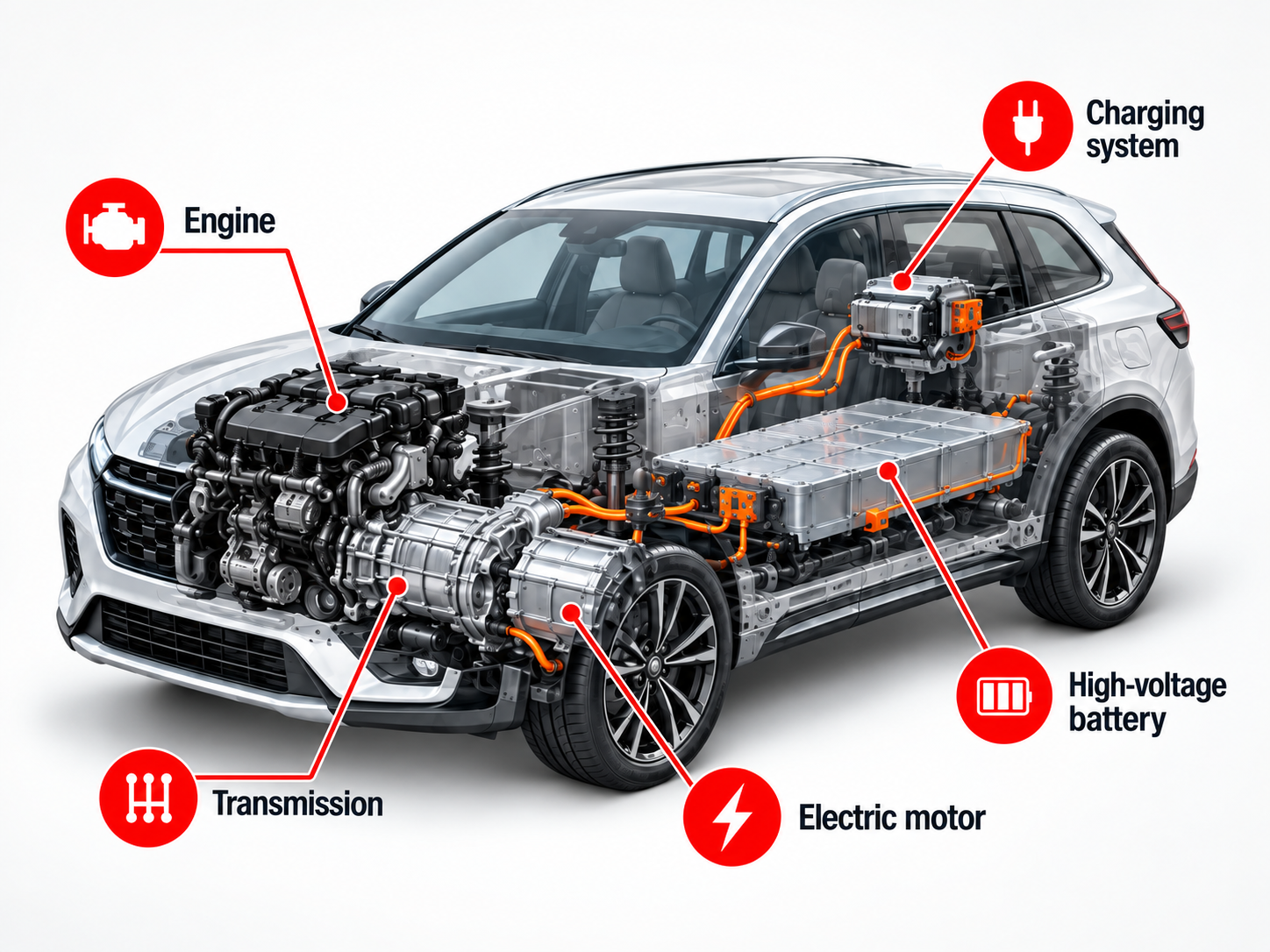
A plug-in hybrid adds another substantial layer of technology. Depending on the vehicle, that can include the high-voltage traction battery, electric motor, inverter and power electronics, onboard charger, high-voltage cooling system and associated control systems.
The petrol side of the vehicle still needs to be healthy as well.
That doesn't automatically make plug-in hybrids unreliable. It simply means a proper pre-purchase assessment needs to look beyond the things you would normally inspect on a second-hand car.
You aren't just asking whether the engine and transmission are healthy.
You also need to know what condition the electric drivetrain is in.
Our guide to the most common issues found during European pre-purchase inspections explains some of the other areas we assess before someone commits to buying a used European vehicle.
100% charged doesn't mean 100% healthy
This is probably the most misunderstood part of buying a used plug-in hybrid.
The dashboard might say:
Battery: 100%
That tells you how charged the battery currently is. It does not tell you how much of the battery's original capacity remains.
There are two different measurements at play.
State of Charge, or SoC, tells us how full the battery is right now.
State of Health, or SoH, gives us an indication of how much usable battery capacity remains compared with when that battery was new.
So a battery with reduced State of Health can still be charged to 100%.
Think about an older mobile phone.
The screen can show 100% when you unplug it from the charger, but everyone who has owned an ageing phone knows that doesn't mean it will last as long as it did when new.
The same basic principle applies here.
Independent battery-testing specialist AVILOO describes State of Health as an assessment of the battery's current condition relative to its original capacity.
That's why simply plugging a PHEV in, seeing it reach 100% and assuming the battery is healthy isn't enough.
If you'd like the more technical explanation of how battery condition is measured, we've covered that separately in our guide to independent EV battery testing.
What happens as a plug-in hybrid battery loses capacity?
Battery degradation doesn't necessarily mean the car suddenly stops working.
That's actually part of what makes this difficult for buyers.
A PHEV with reduced battery capacity may continue to start, drive, charge and operate without obvious symptoms.
Instead, you may gradually notice:
- less electric-only driving range
- the combustion engine starting earlier
- more frequent engine operation
- higher fuel consumption depending on how the vehicle is used
- the vehicle spending less time operating as an electric vehicle.
The Australian Government's Green Vehicle Guide notes that plug-in hybrid fuel consumption increases when battery charge is low, and that actual battery range varies with factors including charge level, vehicle load, acceleration, braking and accessory use.
For an older PHEV, reduced usable battery capacity means you reach that low-charge state sooner.
The vehicle may still work perfectly well as transportation. But if you bought a plug-in hybrid specifically because you wanted to complete your daily commute predominantly on electric power, losing a meaningful portion of that electric range changes the value proposition considerably.
But doesn't the car keep topping the battery back up?
Yes, to an extent, and this is another area that creates confusion.
A plug-in hybrid can receive energy from several sources.
You can plug it into an external charger. It can recover energy through regenerative braking. Depending on the particular PHEV system and operating mode, the combustion engine can also contribute energy or help maintain battery charge.
The US Department of Energy's Alternative Fuels Data Center confirms that PHEV batteries can receive charge from external charging equipment, regenerative braking and the combustion engine.
But here is the important distinction:
Topping up the battery changes its State of Charge. It doesn't restore its State of Health.
If an ageing battery has lost usable capacity, putting energy back into it doesn't recreate that lost capacity.
It simply fills the capacity that remains.
That's why watching the battery percentage rise and fall while driving doesn't tell you whether the battery itself is still in good condition.
The battery doesn't actually operate from absolute full to absolute empty
The percentage you see on the dashboard also isn't necessarily the battery's entire physical capacity.
Battery management systems protect the high-voltage battery by controlling how much of its total capacity the driver can actually use.
That means there can be battery capacity above and below the driver's usable window that isn't displayed as available driving energy.
Again, that protection is useful. It helps manufacturers manage battery longevity and protect the cells.
But it reinforces why the dashboard battery percentage isn't a battery-health test.
What battery health should an older PHEV have?
There isn't one percentage that automatically makes every plug-in hybrid good or bad.
Make, model, battery chemistry, age, kilometres and how the car has been used all matter.
However, we do now have useful real-world data.
Following its analysis of more than 28,500 plug-in hybrids, ADAC published the following indicative State of Health figures for used PHEV buyers:
| Vehicle kilometres | ADAC indicative minimum SoH |
| 50,000 km | 92% |
| 100,000 km | 88% |
| 150,000 km | 84% |
| 200,000 km | 80% |
These figures should not be treated as universal pass-or-fail numbers for every vehicle sold in Australia.
They're useful benchmarks.
If a particular vehicle tests well below what would normally be expected for its age and kilometres, that's when you want to understand why before buying it.
ADAC specifically recommends battery testing when purchasing a used plug-in hybrid because battery health can vary substantially between otherwise similar vehicles.
Why kilometres alone don't tell you enough
We are trained to look at kilometres when buying used cars.
And they're still important.
But kilometres don't tell the full story with a plug-in hybrid battery.
A battery's condition can be influenced by:
battery age, temperature, battery chemistry, charging behaviour, electric driving usage, battery-management strategy and individual cell condition.
ADAC's analysis found that vehicles with a higher proportion of electric driving had, on average, lower State of Health readings than vehicles where the electric drivetrain had been used less frequently. It also found substantial variation between different manufacturers and individual vehicles.
That makes sense when you consider how a PHEV works.
Its traction battery is much smaller than the battery in a full battery-electric vehicle, yet an owner who regularly plugs the vehicle in may charge and discharge that battery very frequently.
That doesn't mean using the electric drivetrain is bad. That's what the vehicle was designed to do.
It does mean the history behind the kilometres matters.
A degraded battery doesn't necessarily mean a failed battery
This distinction matters when considering the purchase price.
Battery degradation and battery failure are not the same thing.
A battery might continue functioning safely while providing less usable energy than it did when new.
For example, imagine an older PHEV that originally offered enough electric range to comfortably cover the owner's normal daily commute.
Years later, the vehicle may still charge to 100%, but degradation means the available electric range is significantly shorter.
The owner now needs the combustion engine for a portion of the trip that was previously completed electrically.
The car isn't necessarily broken.
But the feature that helped justify buying a plug-in hybrid has become less useful.
That should affect how you assess both the vehicle and its price.
The question isn't just “will the battery fail?”
When people hear “battery health”, the natural concern is catastrophic battery failure and the cost of replacing an entire high-voltage battery.
That's understandable, but it isn't the only financial consideration.
For many buyers, the more relevant questions are:
Does the car still have enough usable electric range for the way I intend to use it?
Is the battery condition normal for this vehicle's age and kilometres?
Are all the battery cells behaving correctly?
Are there charging or high-voltage system faults?
Will I still get the benefit I expect from owning a plug-in hybrid?
And does the vehicle's purchase price reflect the condition of the battery?
Those answers are far more useful than simply asking whether the battery “works”.
What else should you inspect on an older plug-in hybrid?
Battery health should be part of a PHEV pre-purchase inspection, not the whole inspection.
Remember, you're still buying a used car.
For a plug-in hybrid, we would also want to understand the condition of the combustion engine, transmission, brakes, suspension, steering, cooling systems, charging system, high-voltage components and vehicle electronics.
While Accelerate Automotive specialises in European vehicles, our high-voltage battery testing is not limited to European makes.
A complete diagnostic scan is particularly important because stored fault codes may reveal issues that aren't producing a dashboard warning during your test drive.
Service history matters too.
Our used car inspection checklist covers many of the normal mechanical and ownership-history checks worth making before purchasing any second-hand vehicle.
For European vehicles, a specialist pre-purchase inspection takes that further by assessing the systems and failure points we commonly see on Mercedes-Benz, BMW, Audi, Volkswagen and Porsche vehicles.
So, is 10 years too old for a plug-in hybrid?
No.
We wouldn't make a buying decision based on age alone.
Interestingly, the large ADAC study found that the majority of PHEV batteries assessed were ageing within an acceptable and expected range.
That's encouraging.
But averages don't buy cars.
You buy one individual vehicle.
And that's why the State of Health of the PHEV you're considering matters much more than an internet statistic telling you what usually happens.
A well-maintained 10-year-old plug-in hybrid with healthy battery performance may be a far better purchase than a younger example with poor battery condition or unresolved mechanical problems.
Test the vehicle, not the assumption.
Who does an older plug-in hybrid make sense for?
An older PHEV can make plenty of sense when its condition is good and it suits how you're actually going to drive.
It's particularly worth considering if you can regularly charge at home, much of your normal driving fits comfortably inside the vehicle's remaining electric range, you still want the flexibility of a combustion engine for longer journeys, and the purchase price appropriately reflects the age and condition of the car.
What we wouldn't recommend is buying one simply because a once-expensive European PHEV now looks cheap.
Cheap to buy and good value aren't always the same thing.
Before you buy one, get the full picture
When we're assessing an older plug-in hybrid, the aim isn't to find an excuse not to buy it.
It's to give you enough information to decide what that particular car is worth to you.
You want to know:
- the current battery State of Health
- whether there are battery-cell or high-voltage system abnormalities
- the realistic remaining electric range
- whether the vehicle charges correctly
- whether the combustion drivetrain is mechanically healthy
- whether there are stored diagnostic faults
- the service and maintenance history
- whether significant repairs or maintenance are approaching.
That's where an independent battery health assessment and a proper pre-purchase inspection work together.
One tells you what is happening inside the high-voltage battery.
The other tells you what is happening with the rest of the car.
For an older PHEV, you really want both.
Our workshop specialises in European vehicles, but battery health testing can also be carried out on compatible hybrid and EV models outside the European market.
Accelerate Automotive specialises in European EV and hybrid servicing, battery testing, diagnostics and pre-purchase inspections from our Coopers Plains workshop in Brisbane. Our independent high-voltage battery testing, however, is not limited to European vehicles and may be available for compatible hybrid and EV models from other manufacturers.
If you're considering buying a used plug-in hybrid or EV, whether European or not, it is worth understanding the condition of the high-voltage battery before the money changes hands.
If you're considering buying a used Mercedes-Benz, BMW, Audi, Volkswagen, Porsche or other plug-in hybrid, have it assessed before the money changes hands.
The most expensive problems with a used vehicle are often the ones you didn't know you were buying.
Frequently Asked Questions
Is a 10-year-old plug-in hybrid worth buying?
It can be. Age alone doesn't determine whether a plug-in hybrid is a good purchase. Battery health, service history, mechanical condition, electric range and how the vehicle has been used are more useful indicators. Have the specific vehicle inspected and its high-voltage battery assessed before purchasing.
How long does a plug-in hybrid battery last?
There isn't one lifespan that applies to every PHEV battery. Battery ageing varies with battery design, temperature, usage, charging behaviour and the vehicle's battery-management strategy. Large-scale testing by ADAC found most PHEV batteries aged within an expected range, but there was significant variation between individual vehicles.
What is a good battery State of Health for a used plug-in hybrid?
It depends on the vehicle's age, model and kilometres. As an indicative benchmark, ADAC suggests approximately 92% or more at 50,000 km, 88% at 100,000 km, 84% at 150,000 km and 80% at 200,000 km. These figures are guides rather than universal pass-or-fail limits.
Does 100% charge mean the PHEV battery is healthy?
No. A 100% State of Charge means the battery is currently charged to the top of its usable range. State of Health measures how much usable battery capacity remains compared with when the battery was new. An ageing battery can show 100% charge while holding less energy than it originally could.
Can a plug-in hybrid recharge its battery while driving?
Yes. Plug-in hybrids can recover energy through regenerative braking, and some PHEV systems can also use the combustion engine to generate or maintain battery charge. This increases State of Charge but does not reverse battery degradation or restore lost capacity.
What happens when a plug-in hybrid battery degrades?
The vehicle may continue operating normally, but electric-only range can reduce. This can cause the combustion engine to operate more frequently and may reduce some of the fuel-saving benefit that made the plug-in hybrid attractive in the first place.
Should I get a battery test before buying a used PHEV?
Yes, particularly when purchasing an older plug-in hybrid. Battery condition cannot be reliably determined from vehicle age, kilometres or the dashboard charge display alone. An independent battery assessment provides substantially more information about the battery's current condition.
Can Accelerate Automotive test the battery in a non-European hybrid or EV?
Yes, depending on the vehicle. While Accelerate Automotive specialises in European vehicles, our high-voltage battery testing is not restricted to European makes. Contact us with the make, model and year so we can confirm compatibility and testing options.










 07 2143 8047